


Table of contents
Introduction
If you run a business in San Antonio, getting more local customers is rarely a matter of simply putting your phone number on a website and hoping people call. Customers have choices. They search, compare, check reviews, look at photos, ask friends, visit social profiles and decide whether a business feels credible before they ever make contact.
That makes your website one of the most important parts of the local customer journey.
San Antonio is a particularly interesting market for this kind of strategy. The U.S. Census Bureau estimates the city had 1,548,422 residents in July 2025, an 8.0% increase from its 2020 estimates base. Census data also reports that 64.6% of residents identify as Hispanic or Latino, 15.0% are foreign-born, and 40.4% of residents age five and older speak a language other than English at home. Broadband internet subscriptions are reported in 91.0% of households.
Those numbers do not mean every San Antonio customer behaves the same way. They do show why local businesses should think carefully about accessibility, language, mobile experience, neighborhood relevance and clear communication.
San Antonio also has an active small-business ecosystem. The city’s Economic Development Department identifies its Small Business Division as the lead for city efforts to grow and develop small businesses, while resources such as Launch SA and the UTSA Small Business Development Center provide support to entrepreneurs.
So what does a website designed to get more local customers actually need to do?
It needs to make the right customer feel that they have found the right business, answer the questions that stand between interest and action, and make contacting or buying from the company remarkably easy.
This practical guide shows you how to build that kind of San Antonio website. naturally from discovery to understanding, trust, action, and ultimately business.
What Makes Local Customer Acquisition Different in San Antonio?
Local customer acquisition is about more than ranking for the phrase “San Antonio.” A customer may be searching from the Medical Center, Stone Oak, the South Side, Alamo Heights, West Side, Leon Valley, the I-10 corridor or another part of the metropolitan area. They may be looking for a neighborhood restaurant, a home service, a professional provider, a retailer or a B2B company.
The website therefore needs to connect three things: the customer’s need, the business’s solution, and the customer’s local context. If those three pieces are clear, the website becomes much more useful as a sales tool. If they are missing, a site can receive traffic without producing enough enquiries.
Start With the Local Customer, Not the Website Template
Before choosing colors, menus or homepage sections, identify the people you want to attract.
A plumber and a wedding photographer may both operate in San Antonio, but their websites should not look or behave the same. A restaurant serving tourists and downtown workers has a different customer journey from a pediatric practice serving families in surrounding neighborhoods. A commercial contractor may need a very different conversion process from a local cleaning company.
Write down who your highest-value local customer is, what problem they are trying to solve, what causes them to start searching, what information they need before contacting you, what objections stop them from buying, which areas you genuinely serve, and what makes your business a better fit than another local option.
Your answers become the foundation for the website.
1. Make Your San Antonio Website Immediately Local
A local website should give visitors confidence that the business actually understands and serves the market. That does not require covering every page in city references. It means making legitimate local information easy to find.
Depending on the business, this can include San Antonio service areas, physical location and directions, neighborhoods or communities served, local projects and customer stories, a local phone number, appointment or service availability, delivery or travel coverage, and relevant local partnerships or community involvement.
For example, a landscaping company could show projects across the parts of the city where it actually works. A restaurant can make its location, parking, hours and ordering options prominent. A professional service can explain whether it serves clients throughout Bexar County or primarily meets customers at its San Antonio office.
The objective is reassurance, not keyword stuffing.
2. Build Location Pages Only When They Help Customers
Local SEO often creates the temptation to build a page for every city, neighborhood and ZIP code. That can produce dozens of nearly identical pages that add little value.
Instead, ask whether a location page can answer questions that are genuinely different for customers in that area. A useful page can explain services available there, typical customer needs, relevant completed projects, service or delivery details, distance or scheduling considerations, a local FAQ, and a clear contact option.
San Antonio is geographically broad enough that legitimate service-area content can be valuable, but it should reflect how the business actually operates.
3. Make Mobile the Primary Local Experience
A customer might search for your business while sitting in traffic, walking through a shopping district, standing outside a venue, preparing for a home repair or comparing providers at the kitchen table.
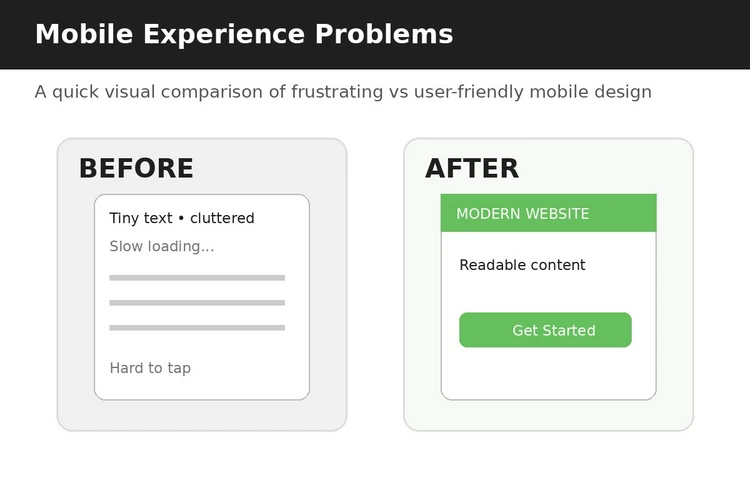
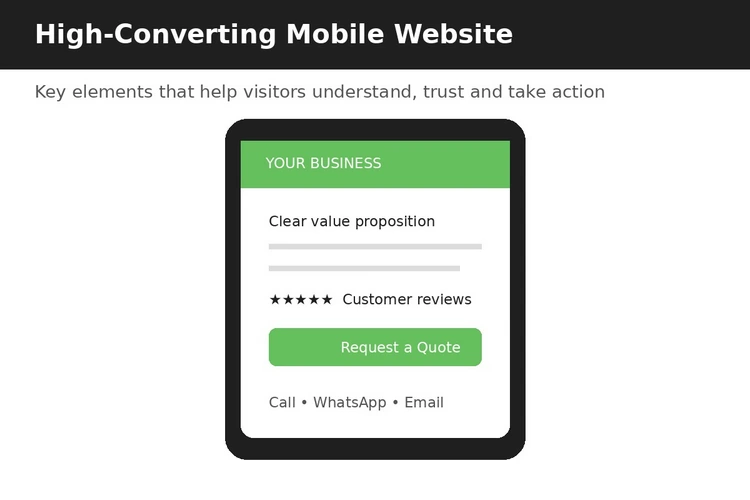
The phone is often the bridge between search and action. A mobile-first San Antonio website should make it easy to call the business, get directions, request a quote, book an appointment, view hours, read essential service information, open a menu, find pricing information where appropriate, or send a message.
Do not force mobile visitors through a desktop-style maze. If a customer has already decided they want to talk to you, the website should not make them search for the phone number.
Is Your Website Turning Mobile Visitors Away?
Get your website checked for mobile usability, speed, navigation and conversion issues.
Turn Your Homepage Into a Local Customer Guide
A homepage should help a new visitor orient themselves quickly.
A useful structure for many San Antonio businesses is: hero section explaining what you do and who you serve; proof through reviews, results, years of experience or credentials; core services; local relevance; process; FAQs; and a clear CTA.
This structure works because it mirrors the questions a customer naturally asks.
1. Use Real San Antonio Proof
Local customers want evidence. If you have completed projects in San Antonio, show them. If customers have left detailed reviews, use them. If your team has served the community for years, explain what that experience means for the customer. If you have partnerships, certifications or relevant qualifications, present them clearly.
Real proof can include project photography, before-and-after examples, customer stories, video testimonials, team photos, case studies, product photos, local event participation where genuinely relevant, and professional credentials.
A stock image of a smiling person holding a clipboard does not prove that your company can solve a customer’s problem. Your actual work does.
2. Build Service Pages That Match Local Search Intent
A visitor searching “emergency plumber San Antonio” is not looking for the same page as someone searching “plumbing maintenance tips.” One has strong commercial intent. The other may be researching.
Your website should support different stages of the decision. High-intent service pages should be direct: explain the service, who it is for, the process, relevant service areas and how to get started. Educational content can answer earlier questions and guide readers toward the relevant service when appropriate.
This creates a path: Question → Helpful answer → Relevant service → Proof → Contact.
3. Make Local Search and Website Architecture Work Together
Search engines need to understand what each page is about. Customers need to understand the same thing.
A simple local service business might use: Homepage → Service pages → Location/service-area pages → Case studies → FAQs → Resources → Contact.
Each layer has a purpose. The homepage establishes the business. Service pages target specific commercial needs. Location pages clarify legitimate coverage. Case studies provide proof. FAQs reduce objections. Resources capture informational searches. Contact pages convert intent into action.
Internal links should connect these pages naturally so customers and search engines can move through the site.
Write for San Antonio’s Diverse Audience
San Antonio’s population is culturally and linguistically diverse. Census data reports that 40.4% of residents age five and older speak a language other than English at home, while 64.6% identify as Hispanic or Latino.
For some businesses, that makes bilingual or multilingual communication commercially important. But translation should be treated as a real customer-experience decision, not a decorative SEO tactic.
If Spanish-speaking customers are an important part of the audience, consider professionally translated pages and a consistent process for navigation, forms, customer support and important service information. Do not simply translate a few headlines and leave the rest of the customer journey in English.
Also remember that accessibility goes beyond language. Use readable typography, strong contrast, clear forms, descriptive links and straightforward navigation.
1. Use Neighborhood Context Without Stereotyping
San Antonio’s neighborhoods and communities have their own histories, commercial patterns and identities. City resources include neighborhood and community planning information, and economic-development programs work with different areas and commercial districts.
For a business, local context can be valuable when it is authentic. If you serve the South Side, say so when appropriate. If your customers come from Alamo Heights, Stone Oak, the Medical Center, the West Side or other areas, make genuine service coverage clear. If your business participates in a neighborhood organization or community event, show that involvement accurately.
But avoid turning neighborhoods into marketing stereotypes. The strongest local message is: “We actually serve people here,” supported by evidence.
2. Use Reviews to Remove the Last Layer of Doubt
Local customers often compare several businesses that appear to offer the same service. Reviews can help break the tie.
Put relevant testimonials near the service or decision they support. A dental service page can feature patient experience relevant to that service. A remodeling page can show a homeowner testimonial alongside the project. A restaurant can highlight customer comments alongside menu or experience information. A B2B page can show client outcomes near the service being evaluated.
Do not fabricate reviews or create misleading testimonials. Trust is an asset that becomes more valuable as the website grows.
3. Make Your Call to Action Specific
“Contact Us” is not always the strongest CTA. A more specific action can reduce uncertainty: Request a Free Estimate, Book an Appointment, Schedule a Consultation, Check Service Availability, Get Directions, Request a Quote, Order Online, or Talk to Our Team.
The best CTA depends on the business. A local restaurant may want “View Menu” or “Order Now.” A law firm may use “Schedule a Consultation.” A home service company may use “Request an Estimate.”
The CTA should describe what happens next, not simply tell people to contact the business.
4. Explain What Happens After the Customer Clicks
A customer may hesitate because they do not know what happens next. If they request an estimate, when will they hear back? If they book a consultation, how long is it? If they submit a project enquiry, what information should they provide? If they call, who answers? If they visit, where should they park?
Small details can remove large amounts of uncertainty. A short “What happens next” section can therefore become a powerful conversion element.
Make Contact Forms Short Enough to Complete
The purpose of a first contact form is usually to start a conversation, not conduct a full interview. For many businesses, a basic form can ask for name, phone or email, service needed, general location and a short description. More complex businesses may need additional information, but every field should have a purpose.
On mobile, long forms are particularly frustrating. If you need detailed information, consider collecting it in stages.
1. Create Content Around San Antonio Customer Questions
A useful local content strategy begins with questions customers actually ask: How much does a service cost in San Antonio? How long does it take? What should I do before a contractor arrives? What questions should I ask before choosing a provider? Do you serve my part of San Antonio? Do you offer same-day appointments? What is included?
The content should answer the question genuinely. At the end, offer the relevant next step. This is how content becomes lead generation instead of simply adding words to the website.
2. Use Seasonal and Local Buying Moments
San Antonio businesses can often build useful content around seasonal demand, local events, weather-related needs, holidays, tourism patterns or annual customer behavior.
A home-service company may publish seasonal maintenance guidance. A restaurant may create holiday catering content. A retailer may prepare local event or gift guides. A service business may publish preparation checklists before peak seasons.
The key is to create content before customers need it, not after the demand has already passed.
3. Design for Visitors Who Are New to San Antonio
San Antonio is not only a market of long-time residents. A growing city also receives newcomers, visitors, students, workers, military-connected households and people relocating for business or family reasons.
A local website can help these customers by being unusually clear about practical details: where you are located, which areas you serve, whether you offer delivery, whether parking is available, whether appointments are required, your hours, how quickly you can respond, and what a first-time customer should expect.
This kind of information can turn a stranger into a customer faster than another paragraph about company values.
4. Think Beyond San Antonio Without Losing Local Relevance
Some businesses eventually grow from San Antonio into surrounding communities and the broader Texas market. The website should allow that growth without weakening its local identity.
You might begin with San Antonio → service pages → Bexar County coverage → nearby communities where genuinely served → broader Texas expansion when justified.
Do not claim coverage that the business cannot actually provide. A strong local website should be expandable, but it should remain truthful at every stage.
Build a Website That Supports Small-Business Growth
San Antonio’s small-business ecosystem includes city resources, Launch SA, the UTSA SBDC and other organizations that help entrepreneurs build sustainable businesses.
A growing business therefore needs a website that can grow with it. Start with the essential customer journey, then create room for additional services, new case studies, more locations, educational resources, team growth, online booking, ecommerce and customer portals where needed.
Do not build unnecessary complexity on day one. Build a structure that can accommodate reasonable growth.
1. Improve Local Conversion With a Simple Offer
Sometimes customers need a reason to take the first step. That reason does not have to be a discount. It could be a free consultation, free estimate, initial assessment, service checklist, downloadable guide, appointment request or quote review.
The offer should make sense for the business and should not promise something the company cannot deliver. Its purpose is to reduce the psychological cost of taking the first step.
2. Use Click-to-Call and Direction Actions Strategically
For local businesses, the website should recognize that a phone call or visit can be the conversion. Place phone numbers where they are easy to use on mobile. Make addresses clickable where appropriate. Provide clear directions. For multi-location businesses, make each location easy to distinguish.
Do not make customers copy an address manually when the business can make the journey easier.
3. Speed and Reliability Affect Local Trust
A customer searching for a nearby provider may be comparing several businesses in a short period. If your website is slow while competitors load quickly, you have created a disadvantage before the customer reads the page.
Performance priorities include compressing images, reducing unnecessary scripts, avoiding oversized video backgrounds, using efficient hosting, testing mobile pages, monitoring important templates, and removing unused plugins or integrations.
A fast website communicates competence quietly. A slow website can undermine it quietly too.
4. Build Local SEO Into Every Important Page
Local SEO should not mean repeating “San Antonio” twenty times. Instead, use natural signals: clear service descriptions, accurate business details, genuine service-area information, relevant location references, useful local content, strong internal links, descriptive page titles, helpful headings, optimized images, customer reviews and consistent business information.
The goal is to make the page useful to a San Antonio customer and understandable to search engines.
5. Create a Google-to-Website Experience
Local customers may discover a business through search before ever seeing the homepage. That means the page they land on matters.
If someone searches for a specific service, send them to the relevant service page rather than forcing them to start at the homepage. The landing page should immediately confirm: “Yes, you found the right service.” Then answer: “Here is what we do. Here is where we do it. Here is proof. Here is what happens next.”
That continuity between search intent and landing-page content is one of the simplest ways to improve local conversion.
Ready to Make Your Website More Mobile-Friendly?
We can help improve your website's responsiveness, speed, usability and conversion experience across smartphones and other devices.
Common Website Design Mistakes
Mistake 1: Treating Every Customer as the Same. A diverse city requires clear audience thinking.
Mistake 2: Using Spanish as Decoration. If bilingual communication is important, support the actual customer journey rather than translating one heading.
Mistake 3: Hiding Local Information. Service areas, hours, location, parking and contact options should be easy to find.
Mistake 4: Sending Every Visitor to the Homepage. Specific searches deserve specific landing pages.
Mistake 5: Using Generic Stock Photography. Local businesses benefit from showing real work, real people and real environments.
Mistake 6: Creating Empty Location Pages. A city or neighborhood name does not create local value by itself.
Mistake 7: Focusing on Traffic Instead of Leads. More visitors are not automatically better.
Mistake 8: Forgetting the Follow-Up. A lead-generation website should connect forms and enquiries to an actual response process.
How to Choose a San Antonio Web Design Partner
When evaluating a web design company, ask questions that reveal whether they understand business outcomes.
Ask how they will research local customers, structure service pages, handle San Antonio service areas, approach mobile-first design, support bilingual audiences if needed, improve conversion paths, measure leads, handle ownership, manage SEO during the redesign, support the site after launch, and test performance.
The strongest partner will connect design decisions to customer behavior and business goals.
1. A Practical San Antonio Website Launch Checklist
Before launch, confirm that the primary customer and offer are clear; the homepage explains the business quickly; major services have dedicated pages; San Antonio service coverage is accurate; relevant community information is natural; real customer proof is visible; reviews are genuine; mobile navigation is simple; phone, directions and contact actions work; forms are tested; language and accessibility needs have been considered; images are optimized; pages load quickly; SEO titles and descriptions are complete; internal links connect services, locations and resources; analytics tracks conversions; business information is accurate; ownership and account access are documented; content maintenance responsibilities are assigned; and the lead follow-up process is ready.
2. Turning a San Antonio Service Website Into a Local Lead Machine
Imagine a hypothetical San Antonio home-services company. Its current website has a logo, a short homepage, a phone number and a generic contact form. The company receives some traffic but few leads.
Instead of immediately spending money on a dramatic visual redesign, the strategy changes the customer journey.
First, the homepage clearly identifies the service and customer. Second, each major service receives a dedicated page. Third, the company adds genuine project photographs and customer testimonials. Fourth, a service-area section explains where the company actually operates. Fifth, the contact CTA becomes “Request a Free Estimate.” Sixth, the form asks for only the information needed to begin. Seventh, common questions about pricing, timing and process are answered. Eighth, the pages are optimized for mobile and performance. Ninth, analytics measures phone clicks and form submissions.
The result is not merely a prettier website. It is a website that removes more reasons for a customer to leave without contacting the business.
3. Local Businesses Should Make the First Interaction Easy
The first interaction with a business can feel like a risk to the customer. Will they pressure me? Will they call repeatedly? Will they quote a price I cannot afford? Will they understand my problem? Will they waste my time?
Your website can answer some of these fears. Explain your process. Tell customers what information you need. Give realistic expectations. Offer low-commitment first steps where appropriate. Show how previous customers experienced the process.
The easier you make the first step, the more likely qualified visitors are to take it.
4. Think of Your Website as a Local Employee
Imagine hiring an employee whose job is to welcome every potential customer, explain the business, answer basic questions, show examples, describe the process, collect enquiries and direct people to the right next step.
A poor employee says, “We are a great company. Call us.”
A useful employee says: “Here is what we do. Here is who we help. Here is where we work. Here is what customers say. Here is what the service includes. Here are answers to common questions. Here is what happens next. Here is the easiest way to get started.”
Build the website accordingly.
Related Posts




LET'S BUILD SOMETHING GREAT
Planning a new website?
Get a professionally designed website tailored to your business goals and budget.
- ✓ 15+ Years Experience
- ✓ 250+ Websites Delivered
Ready to Get Started?
Let's Build a Website That Works for Your Business
Whether you need a professional business website, an ecommerce store, a corporate website, or a complete digital growth strategy, our experienced team is ready to help you achieve your business goals online.
💼
View Our Recent Projects
Explore websites we've designed for businesses across different industries and discover what's possible.
View Projects📞
Book a Free Discovery Call
Speak with one of our website consultants, ask questions, and get expert guidance before making your decision.
Book a Free Call