


Table of contents
Introduction
A beautiful website can make a business look professional. It can use elegant typography, polished photography, smooth animations and a carefully selected color palette. But beauty alone does not answer the questions that matter most to a Fort Worth customer: Can I trust this company? Do they actually serve my area? Have they solved a problem like mine before? Can I reach them easily? What happens after I contact them? And, perhaps most importantly, why should I choose them instead of the next business on Google?
That distinction matters in Fort Worth because the city is no longer a small local market where a company can rely only on word of mouth and a familiar storefront. Fort Worth’s population reached an estimated 1,028,117 on July 1, 2025, according to U.S. Census Bureau estimates, and the city says it has grown 11.9% since the 2020 estimate base. It is now one of the largest cities in the United States and continues to add residents and businesses.
At the same time, Fort Worth’s own economic-development strategy emphasizes high-growth businesses, creative businesses, community vitality and support for entrepreneurs and established small businesses. The city’s revitalization work also treats neighborhoods as distinct communities with different characteristics, priorities and commercial opportunities.
For a local business, that creates an important website lesson: your website cannot simply be attractive. It needs to be useful, credible, local, fast and persuasive.
This is the real purpose of Fort Worth web design. The goal is not to win a design award. The goal is to create a digital front door that makes the right customer comfortable enough to take the next step.
Why a Beautiful Website Is Not Enough
Imagine two Fort Worth landscaping companies. The first has a stunning homepage with cinematic photos, animated sections and a stylish logo. The second has a simpler design, but it clearly explains the services offered, shows recent projects, displays genuine customer reviews, identifies the communities it serves, answers common questions and makes requesting an estimate easy.
Which one is more likely to generate a lead?
The answer is not automatically the second business. Design still matters. A poor-looking website can damage trust before a visitor reads a word. But once a website reaches a reasonable level of visual quality, the bigger question becomes what the design helps the visitor accomplish.
A business website is part of a customer journey. Someone may discover the company through Google, a social post, a referral, a business directory, a neighborhood recommendation or a sign seen while driving. The website then has a short window to turn that initial interest into confidence.
That requires more than aesthetics.
- Clarity — visitors understand what the business does.
- Relevance — visitors can see that the company serves their type of customer and location.
- Proof — the website demonstrates that the business can deliver.
- Usability — visitors can find information without effort.
- Conversion — the next action is obvious and easy.
- Local context — the website feels connected to the Fort Worth market.
- Performance — pages load and work well on phones and other devices.
Is Your Website Turning Mobile Visitors Away?
Get your website checked for mobile usability, speed, navigation and conversion issues.
What Makes Fort Worth Web Design Different?
Fort Worth has a strong sense of place, but it is also a large and geographically varied city. The city government’s revitalization strategy explicitly notes that neighborhoods have distinct characteristics and therefore require tailored approaches. Its target areas include places such as Historic Northside, Historic Southside, Polytechnic Heights, Riverside, Stop Six, Como, East Berry, East Lancaster, Historic Handley, Camp Bowie West and other corridors.
That matters for website strategy. A local business should not think only in terms of “Fort Worth” as one generic audience. Customers can have very different expectations depending on where they live, work, shop or seek services.
A home-service company may need to explain coverage across Fort Worth and nearby communities. A restaurant may depend heavily on customers within a short drive. A professional service may serve clients across Tarrant County. A neighborhood retailer may win business through local familiarity. A company targeting commercial clients may need to communicate differently from one serving homeowners.
The website should reflect that reality without becoming a collection of generic city-name pages.
Trust Should Be Designed, Not Assumed
A common mistake is to treat trust as something a business either has or does not have. In reality, a website can communicate trust through dozens of small signals.
A visitor cannot personally know whether a company is competent. They look for evidence. They notice whether the business provides a real address or service area, whether the team is identifiable, whether reviews seem genuine, whether previous work is shown, whether contact information is easy to find and whether the website answers questions honestly.
Trust is especially important for local services where the customer is making a financial or personal decision. A Fort Worth homeowner inviting a contractor onto their property wants reassurance. A parent researching a local service provider wants credibility. A business owner considering a professional consultant wants evidence of experience.
The website should therefore answer the unspoken question behind every enquiry: “Why should I trust you?”
Trust Signals Worth Showing
- Real customer testimonials with useful context.
- Recent project photography.
- Case studies explaining the problem, work and outcome.
- Team profiles where people are part of the buying decision.
- Relevant certifications, licenses or professional memberships.
- Years in business when the claim is accurate.
- Clear business contact information.
- Transparent service descriptions and expectations.
- Frequently asked questions that address common concerns.
- A clear explanation of what happens after a customer contacts the business.
Local Relevance Is More Than Putting Fort Worth in the Headline
One of the easiest mistakes in local SEO and website design is adding a city name without adding local value. A page that says “We provide quality services in Fort Worth” is not automatically a Fort Worth page. It is a generic statement with a location attached.
Real local relevance comes from experience, coverage, context and useful information.
For example, a roofing company could explain the types of properties it commonly serves, show completed Fort Worth-area projects and explain its inspection process. A restaurant could make its location, parking, hours, menu and event options immediately accessible. A professional firm could explain the kinds of local businesses it works with and the areas where consultations are available.
The difference is substance.
Understanding the Local Audience and Market
Use Neighborhoods Carefully
Fort Worth offers many legitimate opportunities for neighborhood-level relevance, but businesses should resist the temptation to create dozens of thin location pages. If a company genuinely serves Near Northside, Historic Southside, West Fort Worth, the Cultural District, TCU-area customers, Alliance, North Fort Worth or surrounding communities, those relationships can be reflected naturally.
Each useful location page should answer:
- Do you actually serve this area?
- What services do customers there typically need?
- What experience do you have in the area
- Are there practical service or scheduling details customers should know?
- How can someone in this area contact you
If those questions cannot be answered, a location page may not deserve to exist.
Your Homepage Should Behave Like a Good Sales Conversation
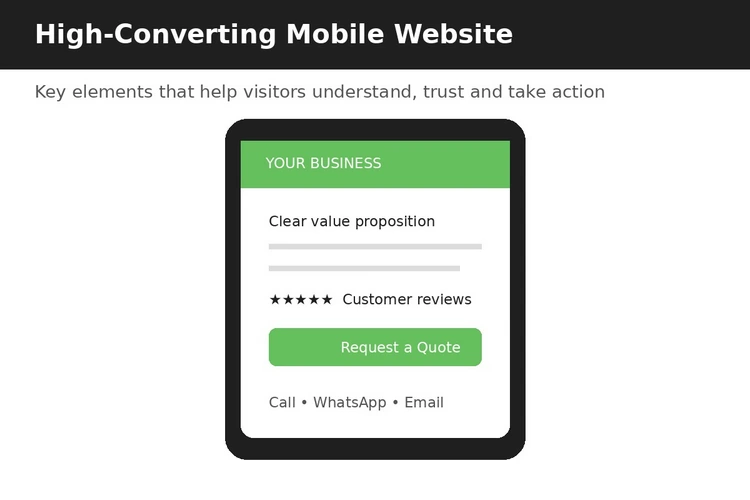
A good salesperson does not begin by listing every fact about the company. They listen, identify the customer’s need, explain the relevant solution, provide reassurance and guide the customer toward an appropriate next step.
Your homepage should do something similar.
A strong Fort Worth business homepage can follow this sequence:
- Identify the customer and problem.
- Explain the service or solution.
- Establish local credibility.
- Show proof.
- Explain why the company is different.
- Answer common objections.
- Provide a clear next step.
This structure is more useful than simply arranging attractive sections until the page looks full.
A Five-Second Homepage Test
Open your homepage and look only at the first screen. Ask:
“What does this business do?”
“Who does it help?”
“Where does it operate?”
“What should I do next?”
If a visitor needs to scroll through several sections before answering these questions, the page may need stronger hierarchy.
The test is simple, but it exposes a common problem: businesses often write websites from the inside out. They begin with company history, values and services because those things are familiar to them. Customers begin with a problem. The website needs to meet them there.
Show the Work Instead of Just Describing It
If your business does visual work, your website should prove it visually. Contractors, remodelers, landscapers, photographers, designers, restaurants, salons, event companies and many other businesses can benefit from real examples.
But a gallery alone is not enough. A collection of beautiful photographs can show that the company produces attractive work without showing how it handles customer problems.
Turn projects into stories.
Instead of:
“Kitchen Remodel — Fort Worth”
try:
“Modern Kitchen Remodel for a Fort Worth Family”
Then explain the starting challenge, the scope, important decisions and final result. Where appropriate, include customer feedback.
This approach creates a case study rather than a photo album.
Make Reviews Work Harder
Many local websites display a row of five-star icons and a sentence such as “Our customers love us.” That is better than nothing, but it wastes an opportunity.
A useful testimonial gives context.
Compare:
“Great company. Highly recommend.”
with:
“We needed our HVAC system replaced before summer, and the team explained the options clearly, completed the installation on schedule and left the property clean.”
The second statement helps a prospective customer imagine their own experience.
Whenever permission allows, connect testimonials to a type of service, project or customer need. Avoid fabricating, exaggerating or selectively editing reviews in ways that change their meaning. Trust grows from evidence, not decoration.
Understanding your local audience is just one part of building a website that consistently generates leads. For a broader framework covering homepage strategy, local SEO, content structure, user experience, and conversion optimization across Texas, read our pillar guide on Web Design in Texas. It brings together the essential principles every Texas business should consider before launching or redesigning a website.
Your Website Should Answer the Questions Customers Are Afraid to Ask
People often leave a website because they are uncertain, not because they dislike the design.
A prospective customer may wonder:
- How much will this cost?
- How long will it take?
- Do you serve my neighborhood?
- What if my project is unusual?
- Will someone actually answer the phone?
- What happens after I submit the form?
- Are you insured or qualified?
- Do you work with businesses like mine?
- Can I see examples?
The exact questions vary by industry, but the principle is universal: objections should become content.
A strong FAQ section can therefore do more than support SEO. It can reduce hesitation before the sales conversation begins.
Building a Professional Brand and User Experience
Mobile Design Is Part of Local Customer Service
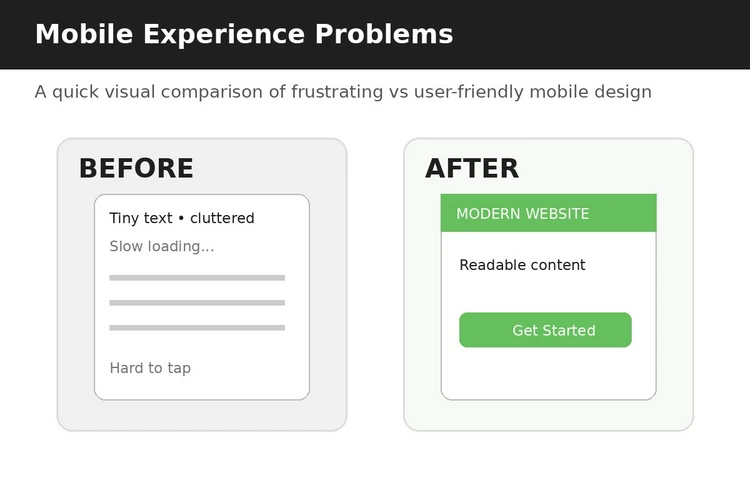
A local customer may discover a business while away from a computer. They may search from a parking lot, at work, from a job site or while comparing providers from home.
That makes mobile usability essential.
A phone visitor should be able to:
- Tap the phone number.
- Find the address or service area.
- View important services.
- Request a quote.
- Book an appointment
- where applicable.
- Read reviews.
- Navigate without repeatedly opening tiny menus.
Forms deserve special attention. If a customer needs to complete twelve fields just to request a callback, the website may be creating unnecessary friction. Ask only for information needed at that stage and collect additional details later when appropriate.
Speed Is a Trust Signal
Slow websites create a subtle credibility problem. If a page takes too long to reveal basic information, visitors may assume the business is less organized or less modern than its competitors.
Performance starts with design choices. Large images, background videos, excessive animations, third-party scripts and poorly optimized plugins can all contribute to slow experiences.
A Fort Worth website should be tested on actual mobile devices and realistic connections. Compress images. Use appropriate image dimensions. Avoid loading resources that are not needed. Keep animation purposeful. Review scripts regularly.
A beautiful website that makes customers wait is not delivering a beautiful experience.
Common Website Design Mistakes
Mistake 1: Making the Logo and Hero Section the Whole Strategy
Branding is important, but customers need more than a logo and an impressive headline. Give them information and proof.
Mistake 2: Using Stock Photos Everywhere
Stock photography can support a design, but it cannot replace evidence of the actual business. Show the team, workplace, products and projects whenever possible.
Mistake 3: Hiding the Contact Information
If leads matter, contact information should not be buried. Make the next step obvious.
Mistake 4: Writing About the Company Instead of the Customer
Your history matters, but the visitor first wants to know whether you can solve their problem.
Mobile, Performance, and Search Visibility
Mistake 5: Copying Competitors
A website that looks like five competitors may be professionally designed but strategically invisible. Identify your real difference and communicate it.
Mistake 6: Creating Dozens of Thin Location Pages
Local SEO is not a license to create duplicate pages with different city names. Build useful location content where there is a genuine customer relationship.
Mistake 7: Treating the Website as Finished Forever
Services, reviews, staff, projects and customer questions change. A good website should be maintained and improved.
How to Choose a Fort Worth Web Design Partner
A strong web design partner should be interested in more than colors and layouts. They should ask about customers, services, sales processes, competitors, service areas, content, performance and business goals.
Before signing a project, ask:
- How will you learn about our customers?
- How will you structure the site around our services?
- How will you handle Fort Worth and surrounding service areas?
- Who will write the content?
- How will mobile performance be tested?
- How will conversion tracking be configured?
- Will we be able to update the website ourselves?
- Who owns the domain and website assets?
- What happens after launch?
- How will the website support SEO?
- Can you show examples where the website solved a business problem, not just examples that look attractive?
A good partner should be able to explain why the design works, not merely why it looks good.
Ready to Make Your Website More Mobile-Friendly?
We can help improve your website's responsiveness, speed, usability and conversion experience across smartphones and other devices.
Turning a Beautiful Contractor Website Into a Trust-Building Website
Consider a hypothetical Fort Worth remodeling company with a visually impressive website. The homepage has large project photos, an elegant logo and a beautiful animation. But the service pages are short, there are no detailed project stories, the reviews are hidden and the contact form asks only for a name and email.
The redesign does not need to throw away the visual identity.
Instead, it can add substance.
The homepage clearly states the company’s remodeling specialties and service area. Each major service gets a detailed page. Projects become case studies. Reviews appear near relevant services. The team is introduced. The process is explained. A simple quote request appears throughout the site. The mobile experience is tested. Images are optimized.
The result may look only slightly different at first glance. But the business function is completely different.
The old website says, “We have a beautiful business.”
The new website says, “We understand your project, we have done this before, people trust us and here is how to get started.”
That is the difference between decoration and conversion.
The Website Should Continue Building Trust After the First Visit
Not every visitor converts on the first visit. A prospective customer may leave to compare prices, discuss the decision with a spouse or business partner, check reviews or simply wait until the need becomes urgent.
Useful content gives them a reason to return.
Case studies, guides, FAQs, project updates and helpful resources can keep the business present during the decision process. This is particularly valuable for services where the buying cycle is longer.
The website should therefore be thought of as a relationship-building tool, not a single-use advertisement.
Frequently Asked Questions
1. How much does Fort Worth web design cost?
There is no universal price. Cost depends on the number of pages, strategy, content, design complexity, functionality, integrations, ecommerce or booking requirements, SEO work and ongoing support. A simple business website and a custom lead-generation platform are very different projects. Define the business outcome and required functionality before comparing prices.
2. What should a Fort Worth business website include?
At minimum, most businesses need a clear homepage, service or product information, trust evidence, contact information and a simple next step. Depending on the business, additional pages may include case studies, service areas, FAQs, team information, resources, booking or ecommerce functionality.
3. Should I create separate pages for Fort Worth neighborhoods?
Only when the business genuinely serves those areas and can provide unique information. A useful local page should help customers understand service availability, relevant experience and the next step. Do not create pages simply by swapping neighborhood names in identical copy.
4. How important are reviews on a Fort Worth website?
Only when the business genuinely serves those areas and can provide unique information. A useful local page should help customers understand service availability, relevant experience and the next step. Do not create pages simply by swapping neighborhood names in identical copy.
5. How important are reviews on a Fort Worth website?
Very important for many local businesses because reviews provide third-party evidence. The strongest testimonials give enough context to help a prospective customer understand what the business actually did.
6. Do I need professional photography?
Not necessarily for every image, but authentic photography can be highly valuable for local businesses. Real people, projects, products and locations provide evidence that stock photography cannot.
Conclusion: Build a Website Fort Worth Customers Can Believe
Fort Worth does not need more websites that are beautiful for the sake of being beautiful. It needs websites that help good businesses become easier to discover, understand and trust.
The city’s rapid growth means local businesses increasingly compete in a larger and more diverse market. Fort Worth’s own economic-development strategy emphasizes creative and high-growth businesses, entrepreneurship, community vitality and neighborhood-specific approaches. That environment rewards companies that understand that local growth is not simply about being present. It is about being relevant.
Your website is one of the few places where a prospective customer can evaluate your business before ever speaking to you. Use that opportunity.
- Show the work.
- Explain the process.
- Make the service area clear.
- Give customers evidence.
- Answer the uncomfortable questions.
- Make mobile use easy.
- Create a clear next step.
- Keep the content current.
And above all, make the website reflect the real quality of the business behind it.
A beautiful website may get someone’s attention. A useful, credible and strategically designed website gives them a reason to stay.
If your business serves customers across Texas, continue with our broader Web Design in Texas guide for a statewide perspective on building a stronger online presence.
Related Posts


Frisco Web Design: How Fast-Growing Businesses Win Online
August 25, 2026

Plano Web Design: Professional Websites for Growing Companies
August 25, 2026
LET'S BUILD SOMETHING GREAT
Planning a new website?
Get a professionally designed website tailored to your business goals and budget.
- ✓ 15+ Years Experience
- ✓ 250+ Websites Delivered
Ready to Get Started?
Let's Build a Website That Works for Your Business
Whether you need a professional business website, an ecommerce store, a corporate website, or a complete digital growth strategy, our experienced team is ready to help you achieve your business goals online.
💼
View Our Recent Projects
Explore websites we've designed for businesses across different industries and discover what's possible.
View Projects📞
Book a Free Discovery Call
Speak with one of our website consultants, ask questions, and get expert guidance before making your decision.
Book a Free Call