


Table of contents
Introduction: The Small Business Website as a Lead-Generation Asset
A customer in Houston can pass several businesses offering the same service before deciding whom to call. A homeowner in Katy may compare three roofing companies on a phone. A patient near the Texas Medical Center may check a clinic’s website before booking. A restaurant customer in The Heights may look at the menu, reviews and directions before leaving home. A business owner in Midtown may compare professional-service firms before requesting a consultation. In each case, the website becomes part of the sales conversation before a salesperson, receptionist or owner ever speaks to the customer.
That is why Houston website design should be treated as a business-growth decision rather than a purely visual project. A good website does more than look polished. It explains the offer quickly, makes the business feel credible, helps the right local customers find the company, answers objections and gives visitors a simple next step.
Houston is a particularly interesting market for this approach because it is large, diverse and geographically spread out. The U.S. Census Bureau estimates Houston’s population at about 2.4 million in 2025, with the city continuing to grow from its 2020 base. The city’s population is also notably diverse, while Houston’s official business portal supports businesses across sectors including food service, lawn care, retail, cleaning, transportation and other local services. These characteristics create a website challenge that a generic template cannot solve: the site has to be relevant to real people in real parts of the Houston area.
This guide presents a practical blueprint for building a business website that can turn local attention into enquiries. It is not about stuffing a page with the phrase “Houston website design.” It is about understanding how a Houston customer thinks, what information they need, what creates confidence and what removes friction at the moment they are ready to act.
Why Houston Businesses Need a Different Website Strategy
Houston is not a one-neighborhood market. A company may describe itself as serving Houston while its actual customers come from a collection of communities and surrounding cities. A contractor might work in Houston, Katy and Cypress. A professional firm may serve Downtown, Uptown and Sugar Land. A family-owned restaurant may depend on customers from a handful of nearby neighborhoods. The website therefore needs enough local context to tell a visitor, “Yes, this business serves people like me.”
The City of Houston itself provides business resources for planning, starting, managing and growing companies, including sector-specific starter kits. That variety reflects the broader commercial character of the city: a website for a restaurant should not be structured like a law firm website, and a home-service company should not be forced into the same customer journey as a medical practice.
Houston Customers Do Not All Need the Same Website
Consider four people searching on the same afternoon. One needs an emergency plumber. One is looking for a family dentist. One wants catering for a corporate event. Another needs an accounting firm. Their expectations are different, even though all four may begin with Google and eventually land on a website.
- Emergency service customer: wants speed, phone access, service area and reassurance.
- Healthcare customer: wants credibility, services, provider information, location and appointment options.
- Restaurant customer: wants menu, hours, photos, location, ordering or reservation information.
- Professional-service customer: wants expertise, proof, clear services and an easy consultation path.
The lesson is simple: design around the decision your customer is trying to make. Do not begin with “Which homepage style looks modern?” Begin with “What must a Houston customer know before they will trust us enough to take the next step?”
The 7 Foundations of a Lead-Generating Website
Houston businesses face unique challenges, but the core principles of building a high-performing website apply across the entire state. For a broader strategy covering planning, user experience, SEO, mobile responsiveness, and business growth, read our complete guide to Web Design in Texas. It expands on the ideas in this article and provides a statewide framework for creating websites that generate leads and support long-term growth.
A Clear Value Proposition Above the Fold
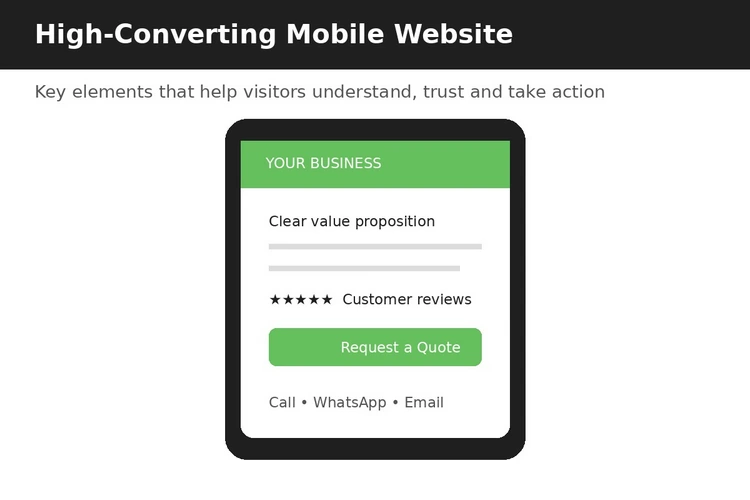
When someone lands on a website, they should not have to decode the business. The first screen should communicate who you help, what you provide and where you operate. A headline such as “Professional Commercial Cleaning for Houston Offices” is immediately useful. A vague statement such as “Excellence Through Innovation” may sound polished but leaves the visitor guessing.
Pair the headline with a short supporting statement and one primary call to action. For example: “Reliable commercial cleaning for offices, medical facilities and retail locations across Houston and nearby communities. Request a site assessment.” The visitor now knows the service, audience, location and next action.
Mobile-First Design Is a Sales Requirement
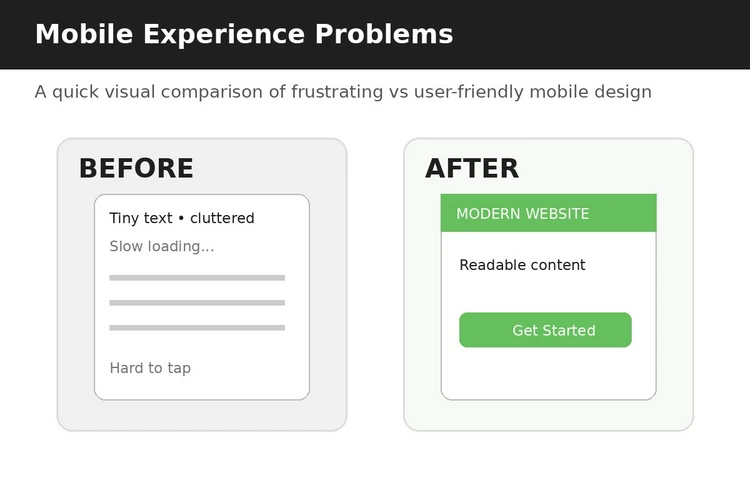
Houston is a mobile-first market in practical terms. People search from vehicles, workplaces, homes, restaurants and job sites. A visitor may discover a business while standing outside a property or comparing providers between appointments. If the phone number is difficult to tap, the form is awkward or the page takes too long to load, the customer has an easy alternative: go back to the search results.
A strong mobile experience should make the primary action obvious. For many local businesses that means a click-to-call button, a short enquiry form, clear service links and a map or directions option. Buttons should be large enough to use comfortably. Text should be readable without pinching and zooming. Images should be optimized so the page does not become a burden on a mobile connection.
Is Your Website Turning Mobile Visitors Away?
Get your website checked for mobile usability, speed, navigation and conversion issues.
Local Positioning and Customer Understanding
Speed Builds Confidence
Website speed is not merely a technical metric. It affects perception. A business that takes several seconds to reveal its services can feel less prepared than a competitor whose website responds immediately. Large hero videos, oversized images, unnecessary animations and poorly managed plugins can quietly undermine an otherwise excellent design.
A Houston business website should therefore be designed for performance from the beginning. Compress photographs, use modern image formats where appropriate, remove unnecessary scripts, keep layouts purposeful and test important pages on real mobile devices. Performance should be considered during design, not treated as a repair job after launch.
Real Houston Photography Creates Familiarity
Stock photography can make a local business look interchangeable. Real images give customers evidence that the company exists, operates locally and has experience doing the work it claims to do. A contractor can show completed projects. A restaurant can show its actual dining room and food. A clinic can introduce its team. A professional firm can show its office and people.
Localization does not mean covering every page with a Houston skyline. In many cases, the strongest local image is simply an authentic photograph of the business, its team or a completed project. The goal is recognition and credibility, not tourism advertising.
One Primary Call to Action Should Lead the Journey
A website can have several useful actions without giving visitors a dozen competing choices. Decide what the highest-value action is. For a service business it may be “Request a Quote.” For a clinic it may be “Book an Appointment.” For a professional firm it may be “Schedule a Consultation.” For a restaurant it may be “View Menu” or “Order Online.”
Use that primary action consistently in the header, relevant service sections and near the end of important pages. Supporting actions can remain available, but the visitor should never wonder what the business wants them to do next.
Local Proof Should Appear Before the Customer Has to Ask
People are cautious about spending money with an unfamiliar company. A website can reduce that uncertainty with proof: reviews, project examples, certifications, memberships, years in business, recognizable clients where permission exists, and specific testimonials. The stronger the claim, the more useful the evidence becomes.
For Houston businesses, testimonials become more meaningful when they provide context. “Great service” is weak. “They replaced the roof on our Cypress home and kept us updated throughout the project” tells a prospective customer what happened, where it happened and what the experience was like.
Navigation Should Feel Obvious
A visitor should not need to study the menu. A straightforward structure such as Home, About, Services, Areas We Serve, Projects or Reviews, Resources and Contact can work well for many local businesses. The exact labels should follow the business, but the principle remains: organize information according to what customers need, not according to how the company is internally organized.
Designing for Houston Neighborhoods Instead of Just Houston
One of the most useful ways to make Houston website design genuinely local is to understand the difference between a city-level page and a service-area experience. Houston businesses may serve Downtown, Midtown, Montrose, The Heights, Uptown, East End, Energy Corridor, Westchase and many communities outside the city limits. Surrounding areas such as Katy, Sugar Land, Pearland, Cypress and The Woodlands can also be commercially important depending on the business.
A service-area page should never be a copied paragraph with a different city name. It should explain why the business serves that area, what services customers there typically request, relevant projects or examples, and how to contact the company. If a business genuinely has experience in Katy, say what that experience is. If it does not serve Sugar Land, do not create a page simply because the keyword appears attractive.
Content, Local Relevance, and Community Connection
What a Lead-Generating Houston Website Looks Like in Practice
Imagine a family-owned HVAC company serving Houston, Katy and Cypress. Its old website says “Quality HVAC Solutions” and displays a large stock photograph. The phone number is in the footer. Services are listed in one long paragraph, and there are no reviews or recent projects.
A redesigned experience could open with a direct message: “Heating & AC Repair for Houston Homes and Businesses.” The supporting text explains service areas and availability. A call button and quote request sit above the fold. The next section introduces common services, followed by real project photographs, customer reviews, service-area links and answers to common questions. The site ends with a simple request form.
Notice what changed. The redesign did not need to invent a gimmick. It simply removed uncertainty at each stage of the customer’s decision. The visitor can identify the service, confirm the area, see evidence, understand the process and act.
That is the essence of lead-generating design: not persuading everyone, but making it easier for the right customer to say yes.
The Role of Content After Launch
A strong website is not only a collection of service pages. Useful content can answer questions that customers ask before they are ready to buy. For a Houston contractor, that might mean explaining how to prepare for a roof inspection after a storm. For a medical practice, it might mean answering common appointment questions. For a restaurant, it could be an event or catering guide. For an accountant, it could be a plain-language explanation of a common business tax question.
The important distinction is relevance. Do not publish articles merely because a keyword tool produced a list. Publish resources that demonstrate expertise, reduce customer uncertainty and create natural reasons to contact the business.
Use Content to Support Services
Every useful article should have a next step. A guide about choosing a roofing material can point readers to the relevant roofing service. An article about preparing for a first dental appointment can link to appointment information. A catering guide can lead to an event enquiry. This creates a connected website rather than a blog that sits separately from the sales process.
A Website Should Reflect Houston Without Becoming a Stereotype
Local content works best when it reflects how people actually interact with the business. Houston is internationally connected, culturally diverse and made up of many distinct communities. The website can acknowledge that reality through accurate service-area information, accessible language, authentic photography and useful local references.
There is also a civic dimension to doing local business well. Houston’s public institutions provide resources for starting and growing businesses, while community organizations work on economic mobility and opportunity. The wider lesson for a business website is that local relevance is about more than putting a skyline behind a headline. It is about understanding the people, places and economic relationships that make the market work.
Avoid making political or cultural assumptions about a customer. A strong commercial website should be welcoming, factual and focused on service. When a business serves multilingual customers, offer meaningful language support. When it serves a particular neighborhood, provide accurate information. When it has community involvement, explain it honestly. Authenticity is more persuasive than performance.
How a Better Website Can Support Business Growth
A website should become more useful as the business grows. A company that begins with three services may later add commercial work, online booking, ecommerce, new locations or additional service areas. Good website architecture makes those changes easier.
This is especially important in a market where surrounding communities can grow and business activity can shift. Recent regional economic reporting has highlighted population growth in places such as Fulshear and Conroe, while communities such as Sugar Land remain important parts of the wider Houston-area business landscape. A business that serves the region should build its website so new, legitimate service areas can be added without rebuilding everything.
Growth-ready architecture might include a well-organized content management system, reusable page components, clean URLs, logical navigation and a deliberate internal-linking structure. The goal is not to build every possible feature on day one. It is to avoid building a website that makes future growth unnecessarily expensive.
When Is It Time to Redesign a Houston Business Website?
A redesign is worth considering when the current website no longer represents the business or creates measurable friction. Warning signs include outdated services, poor mobile usability, slow pages, broken forms, missing security, weak conversion paths, inconsistent branding, outdated reviews or a design that makes the company look less established than it actually is.
Do not redesign merely because another company has a newer color palette. Redesign around a business problem. If visitors cannot understand the service, fix messaging. If they cannot contact the business, fix conversion paths. If the site is slow, fix performance. If local customers do not see relevant information, fix structure and content. The strongest redesigns are driven by evidence.
Ready to Make Your Website More Mobile-Friendly?
We can help improve your website's responsiveness, speed, usability and conversion experience across smartphones and other devices.
Frequently Asked Questions
1. How much does Houston website design cost?
There is no single price because a five-page brochure website, a lead-generation service site and a custom ecommerce platform have very different requirements. Cost can depend on strategy, number of pages, content creation, design complexity, integrations, ecommerce, booking systems, photography, SEO setup and ongoing support. The better question is what the website needs to accomplish and what functionality is necessary to accomplish it.
2. How many pages should a Houston small business website have?
There is no ideal number. A business should have enough pages to explain its services, establish trust, answer important questions and cover legitimate service areas. A focused five-page website can outperform a twenty-page site if the five pages are clearer and more useful. Conversely, a multi-service company may need dozens of genuinely different pages.
3. Should a Houston business create separate pages for Katy, Sugar Land, Cypress and other areas?
Only when those areas are genuinely served and each page can provide unique value. A good location page explains the relationship between the business and the area. Thin pages created only to capture place names can weaken the overall experience.
4. Is WordPress a good choice for Houston businesses?
WordPress can be an effective platform for many business websites because it supports flexible content management, custom design and a wide ecosystem. The platform itself does not guarantee a good website, however. Performance, security, content structure, hosting and implementation matter.
5. How long does it take to build a Houston business website?
A straightforward business website may take several weeks, while a larger project with custom functionality, extensive content, ecommerce or integrations can take longer. Content readiness, approvals and revisions also affect the timeline. A clear scope at the beginning usually produces a smoother project.
Conclusion: Build a Website That Works Like Your Best Salesperson
The strongest Houston website is not necessarily the one with the most animations, the longest homepage or the most fashionable design. It is the one that makes the customer’s decision easier. It tells people what the business does, shows that it understands their needs, proves that it can deliver, makes the local connection clear and gives them a simple way to move forward.
For a Houston small business, that means designing for the reality of the market: a large and growing population, a diverse customer base, a wide geographic footprint and a business community that spans neighborhood shops, professional firms, healthcare providers, contractors, restaurants, retailers and technology companies. The City of Houston’s own business resources reflect this breadth, supporting entrepreneurs across many types of businesses.
If your current website is only an online brochure, it may be time to make it work harder. Review the five-second test. Check the mobile experience. Look at your service-area pages. Read your testimonials. Try submitting your own contact form. Then ask the most important question: “If I were a new customer in Houston, would this website give me enough confidence to contact this business?”
If the answer is no, the opportunity is clear. A strategic website can turn the digital front door of your business into a more useful, credible and measurable part of your sales process.
And if your business serves customers beyond Houston, explore our broader Web Design in Texas guide for a statewide view of website planning, design and business growth.
Related Posts



Frisco Web Design: How Fast-Growing Businesses Win Online
August 25, 2026
Plano Web Design: Professional Websites for Growing Companies
August 25, 2026
LET'S BUILD SOMETHING GREAT
Planning a new website?
Get a professionally designed website tailored to your business goals and budget.
- ✓ 15+ Years Experience
- ✓ 250+ Websites Delivered
Ready to Get Started?
Let's Build a Website That Works for Your Business
Whether you need a professional business website, an ecommerce store, a corporate website, or a complete digital growth strategy, our experienced team is ready to help you achieve your business goals online.
💼
View Our Recent Projects
Explore websites we've designed for businesses across different industries and discover what's possible.
View Projects📞
Book a Free Discovery Call
Speak with one of our website consultants, ask questions, and get expert guidance before making your decision.
Book a Free Call